How the hydraulic circuit of a powered roof support works
A powered roof support is held up by emulsion pressure, moved by valves, and kept safe by a small number of parts that fail first. This page walks the circuit from the pump station to the leg, so that when a part fails you know which one you are looking at.
The circuit in one paragraph
An emulsion pump station supplies pressure through a supply line that runs along the face. Each support takes pressure from that line, holds it in the legs through a lock valve, and releases it through a directional control valve when the support has to advance. A safety valve on the leg circuit opens if pressure exceeds the set value. The return line carries fluid back to the tank.
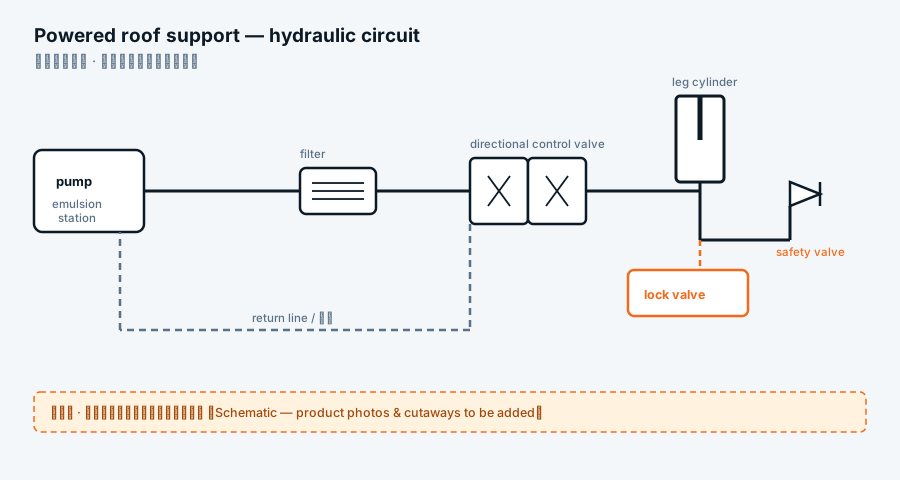
Holding the load: the leg circuit
The legs carry the weight of the roof. Two parts keep them holding: a safety valve, which opens at a set pressure so the leg cannot be over-pressurised, and a lock valve (pilot-operated check valve), which keeps the leg extended when the supply is depressurised. If a support creeps down slowly with the pump running normally, the lock valve is the first part to check; if it drops suddenly under load, look at the safety valve setting.
Moving the support: the control circuit
Advancing, setting and lowering are controlled by a directional control valve — on most modern supports an electro-hydraulic valve bank rather than a manual bank. Each function has its own spool. A support that will not advance in one direction only, while every other function works, points at that single spool rather than at the circuit as a whole.
Keeping the fluid clean: filtration
Emulsion carries contamination from the pipework and from the mine atmosphere. Filters — including auto back-flush types — sit in the supply line upstream of the valves. A filter that has gone into bypass protects nothing: if several valves on the same support start sticking at once, check the filter before suspecting the valves.
When a part fails: what to send us
Most of the parts in this circuit are replaceable without replacing the support. What we need to identify a replacement is one of: the part number stamped on the valve, a photograph of the nameplate, or a drawing of the part. If none of those exist, a worn sample is enough for us to measure — that is what the reverse-engineering service is for.
Direct answers
Short, factual answers to the questions buyers and engineers ask most often. Each answer stands on its own.
What is a safety valve on a powered roof support?
It is a relief valve on the leg circuit. At a set pressure it opens and lets emulsion return to the tank, so the leg cannot be over-pressurised when the roof loads or the support yields. The set pressure is a safety-critical value and must be confirmed against the support specification, not copied from a similar part.
What is a hydraulic lock (pilot-operated check valve) used for on a support?
It holds the leg extended when the supply line is depressurised. A pilot line opens the check when the support is lowered. If a support creeps down slowly while the pump is running normally, the lock valve is the first part to check.
Which valve models does the factory hold mining product approval for?
The single lock valves FDD125/50 and FDD80/50, and the cone-type shut-off valve FJZ400/31.5, carry the MA mining product safety mark. The approval numbers are MEE131131 and MEE131132 for the lock valves. Confirm the covered model list against the certificate before ordering.
Is the working fluid emulsion or oil?
Powered roof supports run on a water-emulsion mixture, not hydraulic oil. That is why the valves are built with corrosion-resistant bodies and why filtration of the emulsion circuit matters as much as the valves themselves.
What does the number in FDD125/50 mean?
FDD designates the product family (pilot-operated check valve, single lock). The 125 and 50 are the model designations used on the nameplate. The exact meaning of each figure is confirmed against the drawing for that model — it is not inferred from the name here.
Can a replacement part be made without a drawing?
Yes, in most cases. Send the failed part and it is measured on a coordinate basis, a dimensioned drawing is reconstructed and sent for approval before manufacture. For simple parts such as a manifold block or a blanking plate, photographs with a rule across the ports are often enough to quote.
What is the minimum order quantity?
There is no minimum for a first trial order. A first order is typically a mixed batch of the parts a maintenance team consumes fastest, so quality can be judged before committing to volume.
How fast is a quotation?
Usually within one working day. Send the part number, a drawing or a photo of the nameplate together with working pressure and quantity.